If you're early in your accounting career, you've probably asked some version of this question: will AI replace me? It shows up in group chats, career-changer DMs, and quiet moments before you commit to the CPA.
I want to give you the honest answer, and then something more useful than reassurance: a way to think about the next ten years.
The short answer: no, AI will not replace accountants. Accounting will not be replaced by AI either, and neither will you. But the reason isn't the one you usually hear. The standard line is "AI won't replace accountants, it will transform the role." That sentence dodges the question.
You're not asking how your duties will change. You're asking whether accountants will be replaced by AI, whether you'll still have a job, and whether the path to senior still exists.
It does. And if you play it right, AI gets you there faster than the generation ahead of you.
For the full picture on AI across accounting workflows, see our AI in Accounting guide.
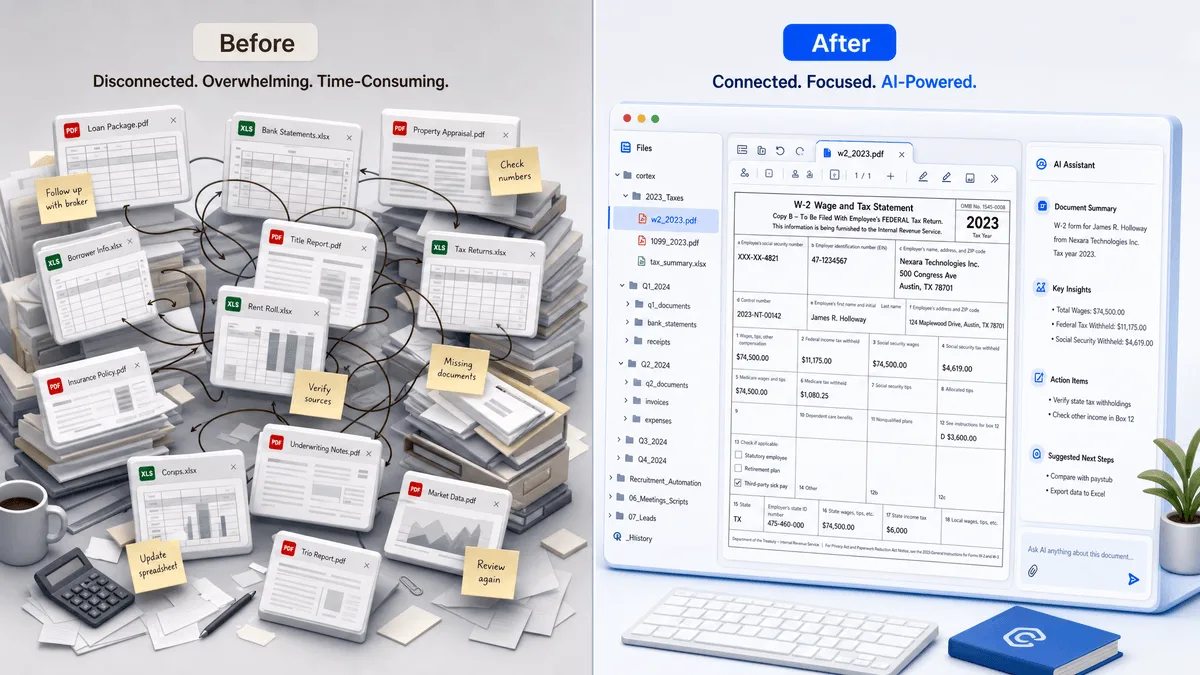
Here's the worry, stated plainly: AI eats the entry-level work, firms stop hiring juniors, and in five years there's nobody with the experience to become senior.
That argument rests on a hidden assumption: that entry-level grunt work is what turns a junior into a senior. Sit with that for a second, because it's wrong, and almost everything downstream depends on seeing why.
Think about what the grunt work actually is. A junior at a Big Four firm described her day to us as "coordinating details." Twelve tabs open. Pull data from one system, paste into Excel, cross-reference a PDF from another team, reformat, compile, send.
Then watch the other team redo half of it because they needed a different format. Three to four hours a day, every day, not on analysis, on moving information between systems.
Did that make her a better accountant? Some of it, at the margins. But be honest about how much.
What actually makes a senior good comes down to two things:
- Experience: varied exposure to projects, industries, clients, and genuine complexity
- Expertise: the degree, the credential, the specialisation, the years of judgment
Neither one comes from reformatting spreadsheets. The "volume teaches judgment" argument has a grain of truth. You do spot a strange transaction because you've seen thousands of normal ones.
But that pattern recognition comes from varied exposure, not from repetition of the same task.
So flip the picture. If AI handles the assembly work, where does your time go? More clients. More industries. More deal types.
A junior who used to manage eight month-end closes a quarter can now sit across fourteen, not by working faster, but by handing off the parts that never taught her anything. She sees complexity sooner. She builds the experience that produces senior judgment, and she builds it years ahead of schedule.
The pipeline doesn't collapse. It accelerates.
Strip away the noise and the advantage comes down to two mechanisms. Understanding both is what lets you act on it deliberately instead of hoping it works out.
The slowest part of becoming a good accountant has always been waiting: waiting for the rotation onto a more interesting client, waiting until you'd done enough closes to be trusted with the messy one, waiting two years to be in the room for a real conversation.
AI compresses the waiting. When the routine preparation is handled, your manager has less reason to keep you on training-wheel work and every reason to put you where the variety is. That variety is the single best teacher of judgment there is. A year of five different industries beats three years of the same monthly close.
This is the part to be intentional about. Variety doesn't arrive on its own. You have to ask for it. Push to be on different client types. Take the unfamiliar deal. Trade the comfortable, repeatable assignment for the one that makes you slightly nervous. That nervousness is the experience compounding.
The second mechanism is quieter but matters just as much. Every hour you spend reformatting and cross-referencing is an hour your attention isn't on the thing that actually creates value: why the number is what it is, what it means for the client, what you'd do about it.
When the assembly work is delegated, you don't just save time. You save cognitive room. You arrive at the variance with your head clear enough to ask the right question instead of being three hours of tab-switching deep and just relieved to be done.
The work that gets you promoted has never been the production of numbers. It's the interpretation. AI shifts the centre of your day toward exactly that.
This is the real promotion engine. People get moved up when they consistently deliver judgment that others rely on. Free your attention from the grunt work and you spend more of it building precisely that reputation.
Knowing the mechanism is one thing. Here's where to put your energy.
This is counterintuitive, so let me be direct. The structural reason accountants won't be replaced by AI is accountability. As AI automates the routine, the licensed professional becomes the load-bearing element of the whole arrangement.
When AI produces a wrong answer, and it will, even top-performing models still hallucinate around 2.1% of the time on financial-domain queries (data from May 2026), inventing tax citations and producing plausible-but-wrong reconciliations.
The accountant who reviewed and signed carries the legal and professional consequence. AI cannot hold a license. It cannot take responsibility. That signature is the entire reason a client trusts you with information they'd never hand to software.
So no, don't skip the CPA, CA, or ACCA on the theory that technical fluency matters more. The technical fluency is table stakes. The credential is the differentiator, and it's worth more in an AI-augmented profession than it was before.
AI is strongest where work is standardised, predictable, and high-volume. It is weakest where work is complex, ambiguous, and jurisdiction-specific. Your career strategy should follow directly from that.
The generalist's old edge was "I know a bit about everything." AI now fills that role cheaply. The specialist's edge, deep command of one genuinely difficult area, stays hard to replicate.
Worth building toward:
- International tax: multi-jurisdiction complexity resists automation
- M&A accounting: high-judgment, deal-specific, rarely standardised
- Audit and risk: professional skepticism sits at the core
- Tax controversy and litigation support: adversarial and high-stakes
- Sector-specific compliance: financial services, healthcare, real estate each demand specialist depth
Pick a direction early enough that you've built real depth by the time it matters.
As preparation work commoditises, the premium shifts to the work that needs a person in the room: the planning conversation, the difficult message delivered well, the translation of analysis into advice a non-accountant can act on.
The profession has historically rewarded technical accuracy over communication, which means these skills are underdeveloped almost everywhere. That's your opening.
The accountant who can say "here's what this means for your business, and here's what I'd do" isn't competing with software. The one who produces accurate numbers and waits to be asked what they mean is on the wrong side of the line.
I don't want to oversell this, because there's a real trade-off and you should go in with your eyes open.
The foundational pattern recognition that came from grinding through thousands of routine transactions doesn't build itself when AI does the first pass. You can lose the instinct for when a number is off if you've never sat with enough normal ones.
So build that instinct deliberately. Don't avoid the AI tools. Learn them well enough to catch their mistakes, because catching the mistake is the skill that depends on knowing the underlying mechanics cold.
Work through the reconciliation by hand sometimes even when the machine has already done it. Pay attention when a senior questions an AI output and ask why. The intuition that used to come for free now has to be earned on purpose.
That's the one genuine cost of the head start, and it's manageable if you're intentional.
It remains a strong choice in 2026, with one caveat worth knowing: both the entry-level experience and the road to senior are changing.
The credential holds its value, arguably more than before, since professional accountability is what makes the service worth paying for. The day-to-day is shifting toward earlier complexity and less routine prep, which is a better career in most respects, not a worse one.
The skills worth building alongside the technical qualification, judgment, a specialisation, the ability to advise, don't replace the core training. They make it worth more.
AI raises the floor on what clients expect from basic accounting. It does not raise the ceiling on what an experienced, credentialed, trusted accountant can deliver. That gap between floor and ceiling is your whole career, and AI is handing you a faster way to climb it.
The accountants best positioned for the next decade aren't the ones racing software on the tasks it does fastest. That's a race you lose.
They're the ones who let it clear the grunt work, then spend the time it returns on the things it can't touch: varied experience, deep specialisation, real judgment, and the accountability only a person can hold.
You have a head start the last generation didn't. Use it on purpose.